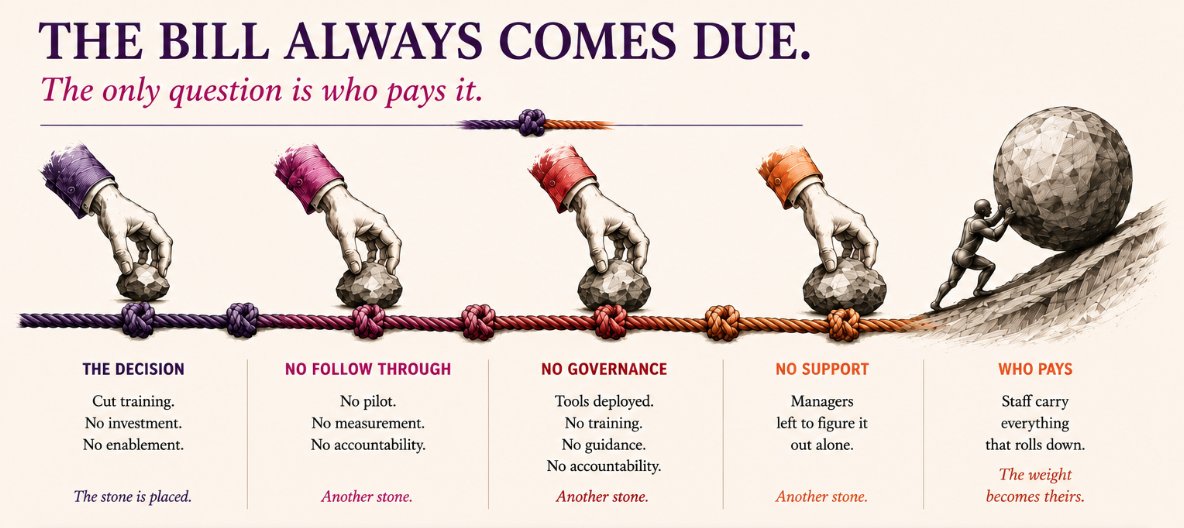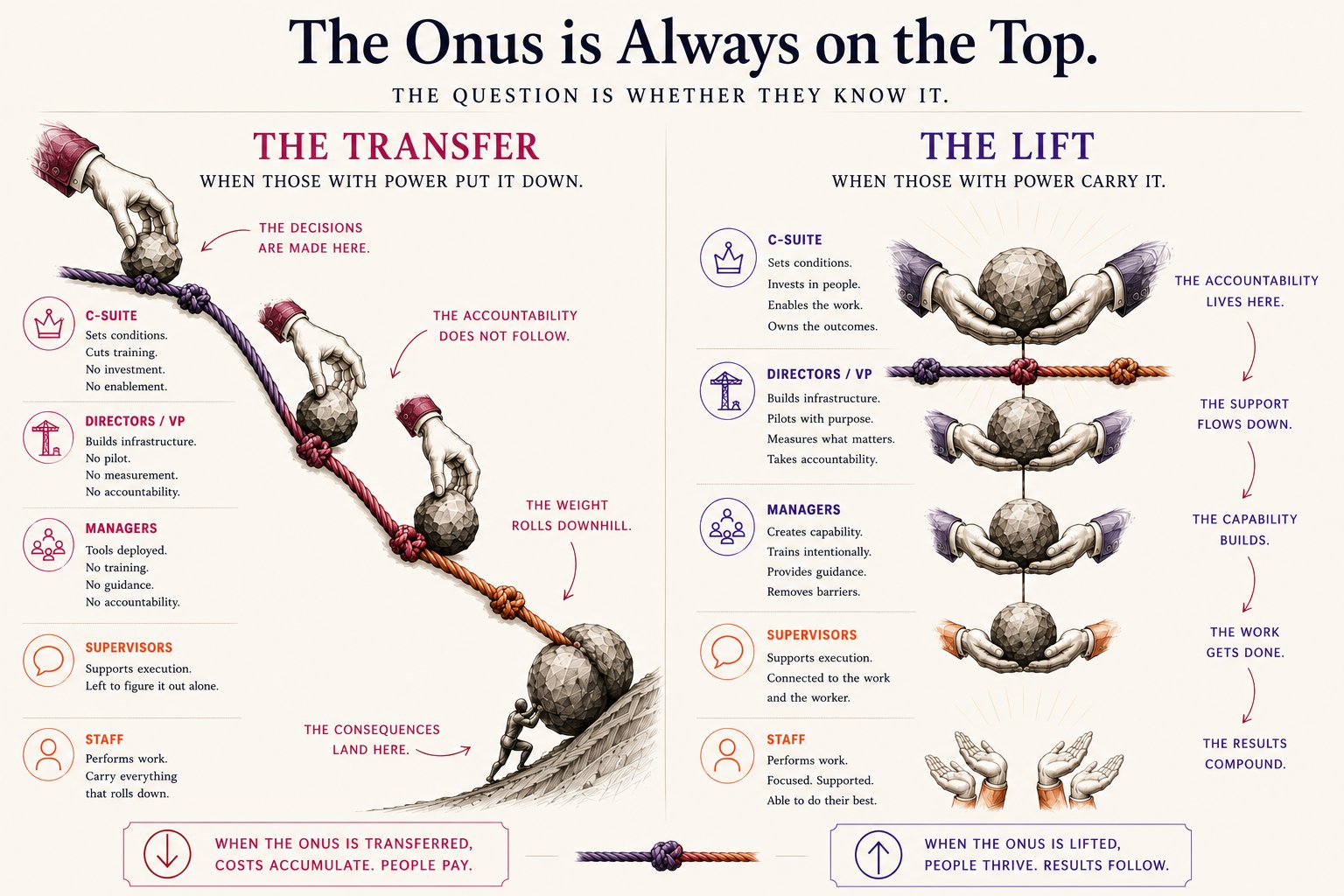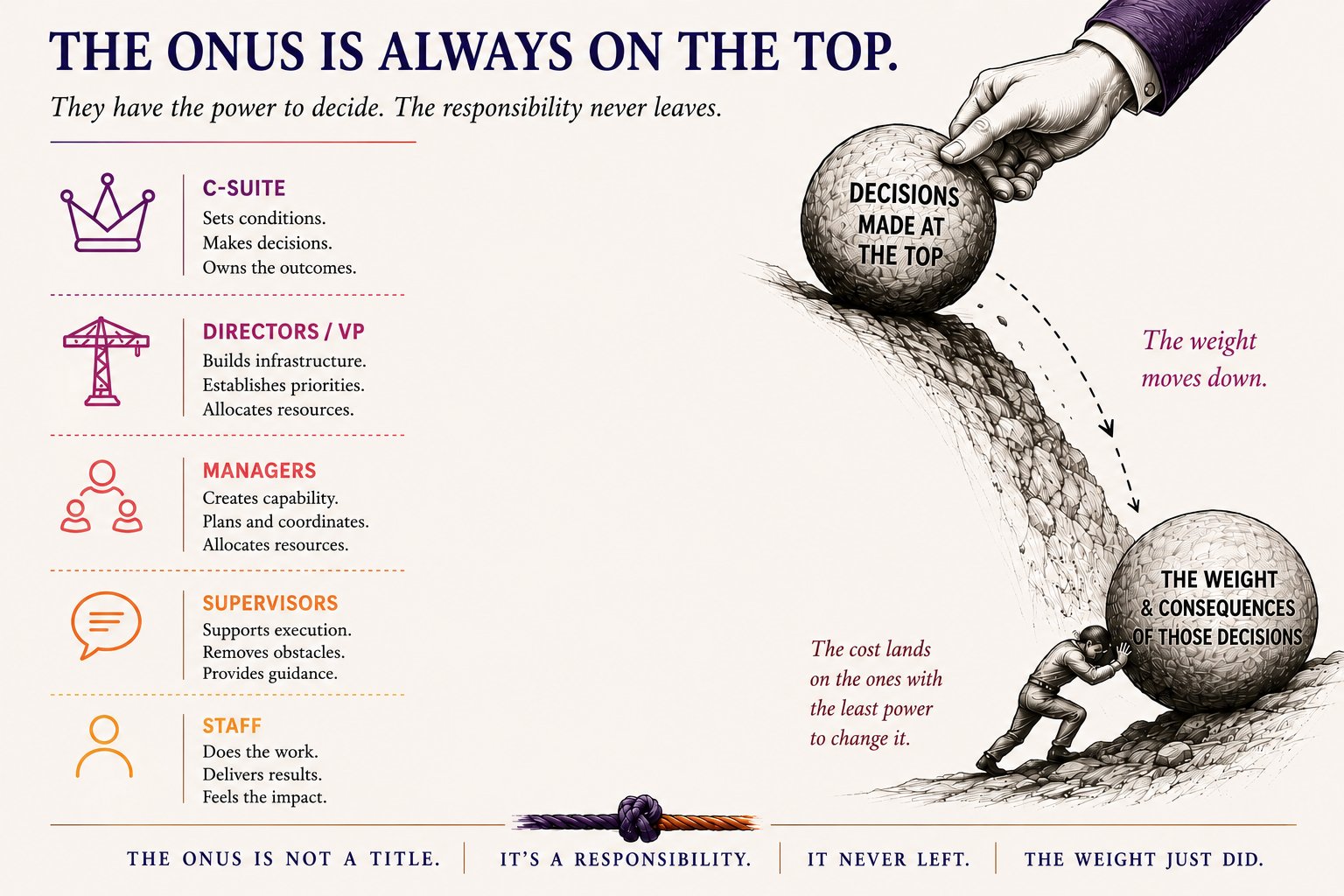
For 15 years, the compliance training I built and delivered included a module on fraud, waste, and abuse. It taught people to recognize misuse of resources, document it, report it. It was thorough. It was evidence-based. And it pointed entirely at the workers.
Fraud, Waste, and Abuse as a formal compliance requirement applies to organizations handling federal health programs, Medicare, Medicaid, and government grant funding. That is not the argument here. This paper is about the organizational pattern that exists everywhere — where scrutiny consistently lands on the smallest expenditures at the bottom while the largest decisions at the top go unquestioned. Every organization has rules about not wasting company resources. Most apply them in one direction only.
The same scrutiny pattern that defunds training budgets and eliminates instructional designers also governs how organizations deploy AI. It is the most expensive version of this mistake yet — and the numbers make that impossible to argue with.
And the one that should be embarrassing to say out loud: half of all installed software goes unused. Not a little. Half. $45 million per month in waste. The licenses auto-renew. Nobody connects it to the training budget that was cut three years ago. Want to know why software goes unused? Because nobody trained anyone to use it. It eats itself.
The argument for universal AI training lives in a companion paper. Read Train Everyone. No Exceptions. This paper is not that argument. This paper is what the pattern cost you — in AI, in training, in every budget decision where the tool got protected and the people didn't.
What organizations are doing when they hand authoring tool licenses to subject matter experts and eliminate their training staff is putting a full refrigerator and a cookbook in front of someone who has never cooked — and walking away saying they've solved the dinner problem.
This is not an argument against subject matter experts. SMEs are essential. They know the content. The argument is against confusing them with the people who know how to build learning systems — because those are two different jobs. And while we're here: an instructional designer and a trainer are not the same job either. A trainer and a facilitator are not the same job. These distinctions exist for reasons. Here is what those reasons look like from the inside — as evidence of what gets lost when organizations collapse these roles to save money:
And that is still just three of the roles. Before the cuts, a fully functioning L&D — or Organizational Effectiveness — operation was a system. Every role purpose-built to move an entire organization's behavior in the same direction. Here is what that system looked like:
Every one purpose-built. None interchangeable. All working together to ensure the entire organization was moving in the same direction — which is what it actually takes to change behavior at scale.
Common objections. Answered. If you've read this far and a question is forming — good. Here are the ones that come up most often, with answers that don't require you to take anyone's word for it.
AI generates from pattern matching. The instructional designer generates from context. One of them cannot replace the other for the part that matters most.
Diagnosing a gap before defaulting to training is correct. Not every problem is a training problem. That principle is valid.
The organizations using "be strategic" as the reason they have eight instructional designers for 8,000 employees are not being strategic.
They are being penny-wise and pound-foolish and calling it strategic.
A real California regulatory requirement. A real organization. A real training failure. The company is unnamed. The regulation is public. The consequences are exactly what happens when you measure the wrong things.
Reveal each step to compare both tracks side by side — and watch the costs add up.
| Cost Category | When Training Gets Cut | When Done Right |
|---|---|---|
| Initial training cost / "savings" | $289 saved | $4,756 |
| Supervisor rework × 12 months | $20,160 | $336 (2 weeks only) |
| Staff confusion and rework | $12,000 | $0 |
| 45% turnover — 36 DSPs × ~$3,278 | $117,994 | Reduced |
| New hire cycle | Resets every hire | Same training, no rebuild |
| Compliance exposure | Up to $14.8M | Protected |
| Conservative 12-month total | $169,000+ | <$10,000 |
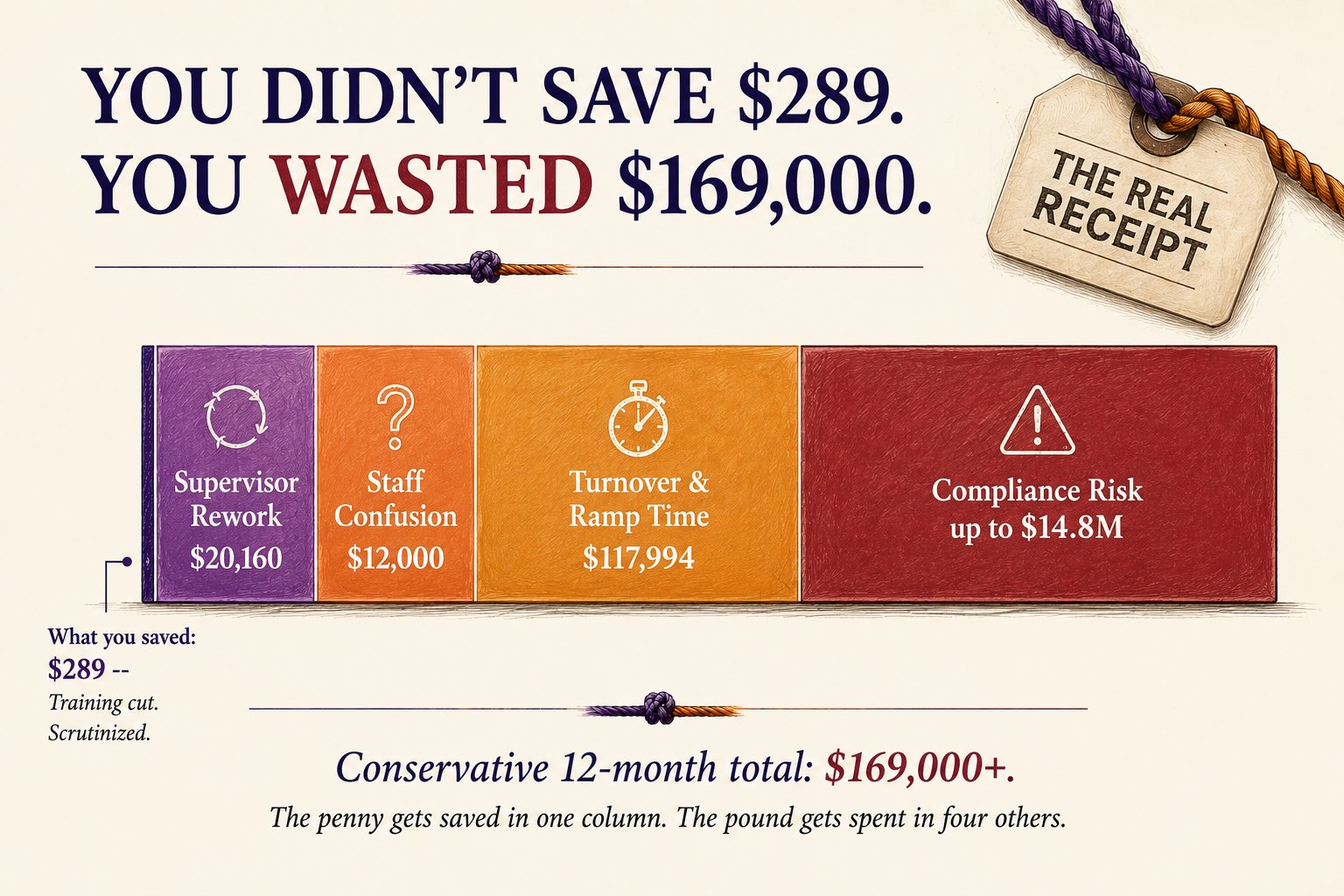
The penny gets saved in one column. The pound gets spent in six others. Because the columns have different owners, nobody ever sees the full number. And then — with a certain audacity — they blame the workers.
The training in this case study was literally one slide — in a bimonthly meeting, announced mid-month, with no follow-up, no single source of truth, and no one assigned to measure whether anything changed.
One slide was the training. Here is what a real training built for this same regulatory requirement actually looks like. See the DSP Documentation Training →
You will not need to see the original slide to understand the gap. The comparison makes itself.
Here is what the DSPs supporting adults with developmental disabilities in California do for $19.60 an hour:
The salary is a legislative problem — a Medicaid reimbursement issue that individual organizations cannot unilaterally solve. But training? Communication? A supervisor who follows up? A single source of truth everyone can find? Those are choices. Within the organization's control. Requiring no legislation. No budget increase from Sacramento.
Someone told me: people just don't want to learn.
I have based my entire career on the belief that people want to do a good job. But when you give them bad training, send contradictory instructions, and make them figure out a compliance requirement on their own time — at some point you have used up something you cannot get back.
Trust doesn't reset. It compounds in the other direction. The next person walks in carrying what the last person experienced. The credibility didn't disappear overnight. It eroded. One policy email at a time. One "that's not my department" at a time.
People noticed. They always notice. You don't get more rope when you fail people. You get less. Every time.
The people who control the budget, the structure, and who gets promoted for what -- they made the decision to give people one slide. The notes that followed -- the confusion, the turnover, the $169,000 -- those are theirs.
The people whose notes did not improve were not the problem. The notes were the output of a system that gave them a slide, no follow-up, contradictory instructions, and no single source of truth. The system produced exactly what it was designed to produce. The only question is who gets held accountable for it -- and the answer, as always, is the people at the bottom.
If you made it this far, thank you for reading.
This is how I think, how I learn, and how I show up in my work and my life.