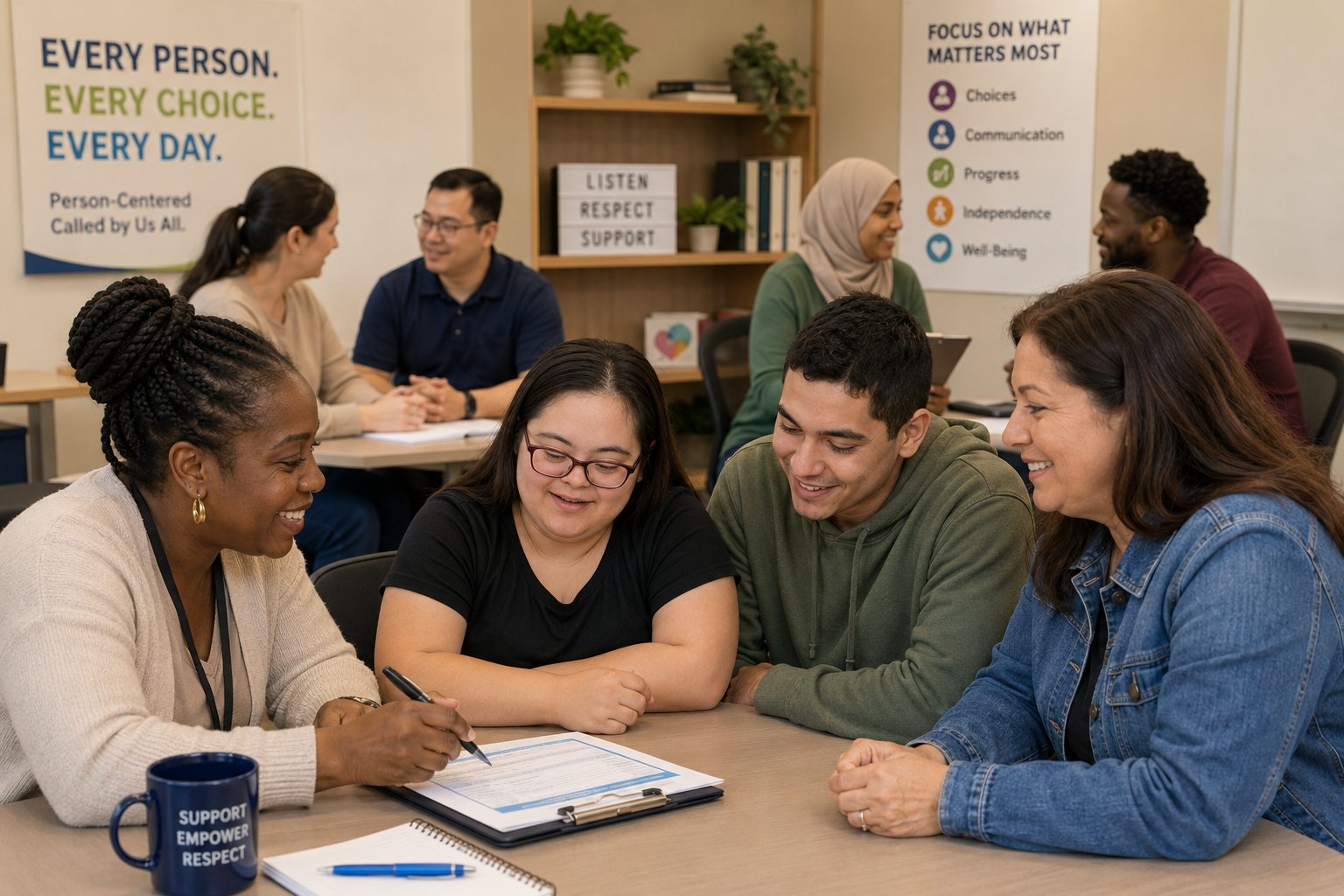
Direct Support Professionals collaborating
California DDS ยท Direct Support Professional Training

Writing Participant-Centered Notes

The participant is the subject of every sentence. They chose.   They tried.   They said.   They achieved.

DDS
California Department of Developmental Services. The state agency that funds and oversees services for people with developmental disabilities.
DSP
Direct Support Professional. The person providing direct services and support to participants โ€” that's you.
Regional Center
A nonprofit organization contracted by DDS to coordinate and fund services for individuals with developmental disabilities in a specific geographic region.
Participant
The individual receiving services. In notes, they are always the subject โ€” never a secondary character.
IPP
Individual Program Plan. The document that outlines a participant's goals, services, and supports. Notes should reflect progress toward IPP goals.
Lanterman Act
California's foundational law guaranteeing services and supports to people with developmental disabilities.
Title 17
California Code of Regulations, Title 17. The specific regulations governing documentation standards and service delivery for DDS-funded services.
DSP University
DDS's online training platform for Direct Support Professionals. Provides standardized training and continuing education.
DSPT
Direct Support Professional Training. Required training hours DSPs must complete as a condition of employment.
CCF
Community Care Facility. A licensed residential facility providing care and supervision for individuals with disabilities in a community setting.
Choose Your Path
Recommended

Guided Experience

Work through each section in order. Content unlocks as you go, with a progress tracker to keep you on pace. Takes about 20 minutes from start to finish.

Returning or Browsing

Open Navigation

Jump directly to any section. All content is immediately accessible. Good if you've already completed the training and need a specific topic.

California DDS ยท DSP Training

Welcome. We're glad you're here.

This training is for every Direct Support Professional who writes session notes โ€” whether you've been doing this for years or you're just getting started. The standard has changed. This training will show you what that means, why it matters, and exactly what to do differently.

By the end of this training, you will be able to
  • ๐ŸŽฏExplain the difference between a staff-centered note and a participant-centered note โ€” and why that distinction matters legally and in practice.
  • ๐Ÿ“Identify the six categories of information worth documenting and know which ones make a note strong.
  • ๐Ÿ”Recognize common note-writing mistakes and rewrite them so the participant is always the subject.
  • โœ…Apply the participant-centered standard across different session types โ€” remote, in-person, high support needs, and repetitive routines.
Who DSPs Are
DSPs and participants working together

Direct Support Professionals are the people who make the difference between a plan on paper and a life actually lived. You work one-on-one with participants, learning their rhythms, their preferences, what makes a hard day easier and a good day better. No one else in the system sees what you see. That's not a small thing โ€” that's the whole thing.

What you write in a note is a record of someone's life. It reflects their choices, their growth, their struggles, and their voice. Written well, it protects them. Written poorly, it erases them.

DSP University

DDS offers continuing education and standardized training through DSP University. This training resource is a practical companion โ€” not a replacement for official training. For required certifications, training hours, and official guidance, visit dds.ca.gov or contact your Regional Center.

Why It Changed

The Regulatory Foundation

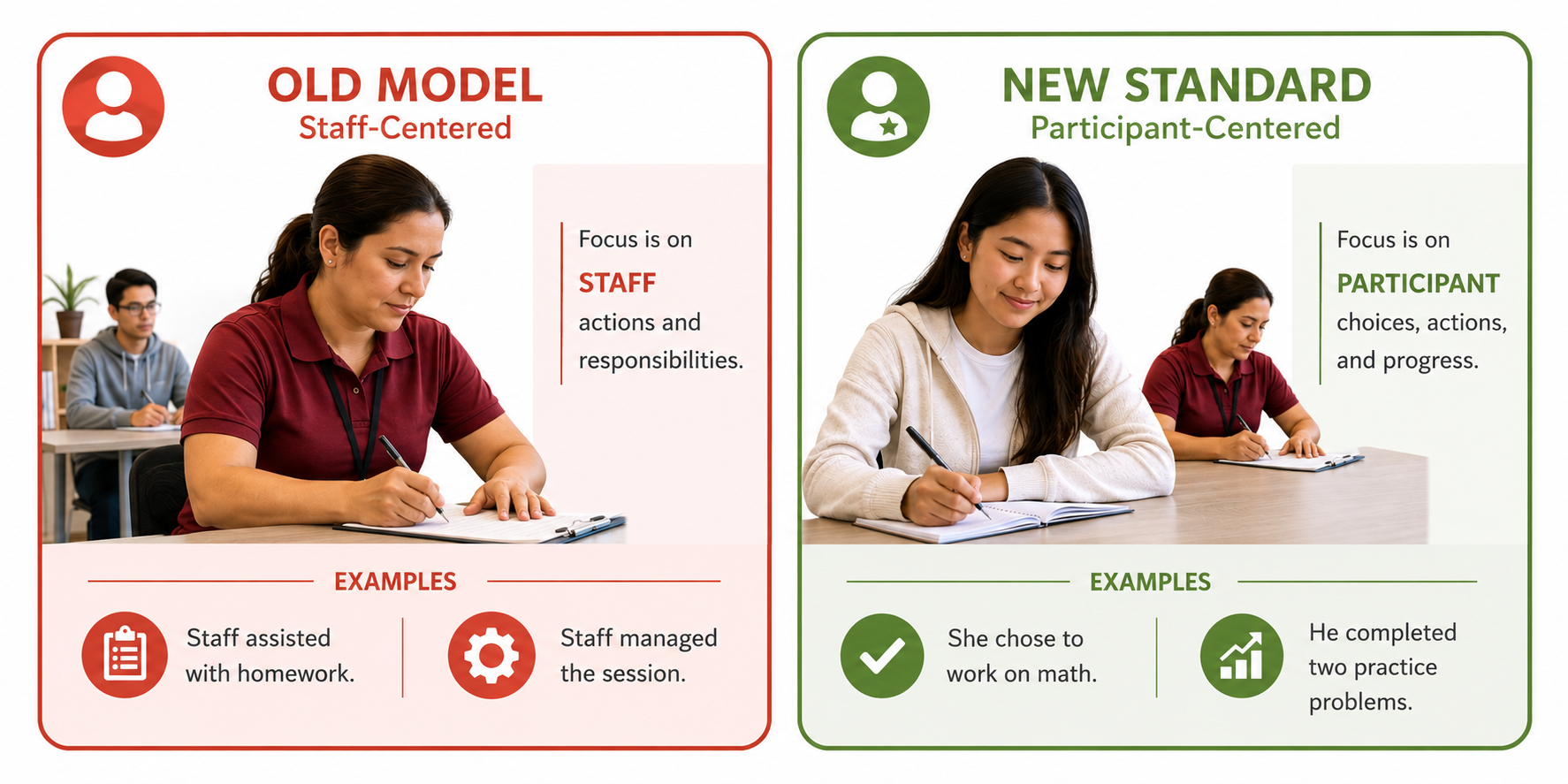
Participant-centered documentation is not a style preference. It is a compliance requirement. The Lanterman Act establishes that people with developmental disabilities have a right to services that respect their choices, dignity, and individuality.

Title 17 of the California Code of Regulations sets the standard: notes must reflect participant outcomes, choices, and progress โ€” not staff activity. An audit that finds staff-centered notes is a finding that a participant's record does not reflect their life.

Lanterman ActTitle 17 CCRParticipant RightsAudit Compliance
Old staff-centered model vs new participant-centered standard
๐Ÿ“Œ
The One Rule

Before you submit, read your note. If staff appears more than once โ€” or appears first โ€” rewrite it. The participant leads every time.

What to Document

Six categories cover everything worth writing. You don't need all six in every note โ€” but you need at least two to tell a real story.

๐ŸŽฏ
Choices
  • What they chose to work on
  • Decisions made during session
  • What they asked for or declined
๐Ÿ’ฌ
Communication
  • What they said or expressed
  • Gestures, eye contact, behavior
  • Questions they asked
๐Ÿ“ˆ
Progress
  • What they completed
  • Growth from prior sessions
  • Skills being built
โšก
Challenges
  • What was difficult and why
  • How they responded
  • Support: brief and specific
๐Ÿ”
Consistency
  • Routines held independently
  • Streaks worth noting
  • What no longer needs prompting
Mini Lesson โ€” See the Categories in Action

Read the note below. The six cards above show which categories it draws from. Use the buttons to move between notes.

Note 1 of 2
Mini Lesson โ€” Note Length

Click each note below to see what works, what to watch, and what needs a full rewrite.

2 Sentences Strong
Tanya arrived with her bank statement and chose to review her spending. She identified one area of overspending independently and asked to work on a plan for next month.
This note works. Two sentences, participant is the subject twice, a choice is documented, and there is a forward-looking action. No staff mention needed โ€” she did it herself.
4 Sentences Watch It
Staff met with Tanya for her weekly budgeting session. Tanya reviewed her bank statement with support. She identified one area where she overspent. Staff provided feedback and Tanya agreed to work on a plan.
This has drifted. "Staff met" leads the note โ€” participant-centered notes never open with staff. Staff appears twice. Tanya's actual choice and initiative are buried. Rewrite to lead with Tanya.
8 Sentences Rewrite
Staff prepared for the session by reviewing prior notes. Staff greeted participant and explained the agenda. Staff presented the bank statement and asked participant to review it. Staff walked participant through each category. Participant identified one area. Staff explained the issue. Staff provided strategies. Session was completed on time.
This is the old model in full. Eight sentences, staff is the subject of seven. The participant appears once, passively. There is no evidence of choice, initiative, or growth. Start over โ€” lead with what Tanya did.

Click any note to reveal the feedback.

Real Scenarios
DSP supporting participant in a college session
๐Ÿ‘†Click each tab below to see a real example from that type of session. There are four โ€” make sure you explore all of them.
Scenario: College Support โ€” Zoom Session
The SituationMaria is working toward her AA degree. You meet with her twice a week via Zoom to support her coursework. Today she logged in on time, chose to start with her reading assignment, identified two questions on her own, and asked for clarification on one before the session ended.
Old Way

Staff met with participant via Zoom. Staff reviewed course materials and assisted participant in understanding the assignment. Staff checked in at the end of the session.

Why it doesn't work: Staff is the subject of every sentence. Maria disappears from her own note.
New Standard

Maria logged into her Zoom session on time and chose to begin with her reading assignment. She identified two questions independently and asked for clarification on one. With a verbal prompt, she outlined her response before the session ended.

Why it works: Maria is the subject. Her choices and actions are documented. Staff support appears once, briefly, and specifically.
Scenario: Remote Check-In โ€” Phone Session
The SituationYou do a weekly phone check-in with James to support his independent living goals. Today he brought up a problem with his schedule on his own and proposed a solution before you had a chance to ask.
Old Way

Staff conducted weekly phone check-in with participant. Staff discussed scheduling and provided suggestions. Participant was cooperative. Session completed.

Why it doesn't work: Vague, staff-centered, and tells us nothing about James's growth or initiative.
New Standard

James initiated a conversation about a scheduling conflict and proposed a solution before being prompted. He demonstrated problem-solving skills he has been building over the past month. He ended the call expressing confidence about the coming week.

Why it works: James's initiative, growth, and emotional state are all documented. No staff mention needed โ€” he did this himself.
Scenario: Community Outing
The SituationYou took Darnell to the grocery store as part of his independent living plan. He chose the items on his list, handled the transaction at the register, and asked a store employee for help finding one item without prompting.
Old Way

Staff took participant to grocery store. Staff assisted participant in selecting items and completing the transaction. Staff monitored participant throughout the outing.

Why it doesn't work: "Staff monitored" reduces Darnell to someone being watched. His real achievements are invisible.
New Standard

Darnell selected all items from his list independently and completed the register transaction without prompting. When he could not locate one item, he approached a store employee and asked for help โ€” a skill he has been working toward. He expressed pride in completing the trip on his own.

Why it works: Three achievements documented: independent selection, independent transaction, and self-advocacy. His emotional response is included because it's meaningful.
Scenario: Nonverbal Participant โ€” Daily Living Skills
The SituationRosa is nonverbal and uses gestures and eye contact to communicate. During today's session she indicated her preference by reaching for her preferred activity materials and made sustained eye contact when given a choice between two options.
Old Way

Staff presented activity options to participant. Participant was compliant. Staff provided hand-over-hand assistance throughout the session. Session completed without incident.

Why it doesn't work: "Compliant" reduces Rosa to a passive recipient. Her actual communication is completely absent.
New Standard

Rosa indicated her preference by reaching for her activity materials when presented with two options. She maintained sustained eye contact during the choice-making process, demonstrating active engagement. With hand-over-hand support for one step, she completed the activity and signaled satisfaction by relaxing her posture.

Why it works: Rosa's communication โ€” through gesture, eye contact, and body language โ€” is the center of the note. Support is noted specifically and briefly.
Scenario: Same Routine, Every Session
The SituationYou support Kevin with his morning routine three times a week. It's the same tasks every time. Today was session 14. Nothing dramatic happened โ€” he just did his routine.
Old Way

Staff assisted participant with morning routine. Participant completed tasks. Session went well.

Why it doesn't work: This tells us nothing. It could describe any session for any participant.
New Standard

Kevin completed his morning routine without prompting for the third consecutive session. He self-corrected when he missed a step โ€” a skill he has been building since week two. He moved through the sequence at his own pace and indicated he was ready to move on before being asked.

Why it works: Consistency is progress. Documenting a streak, a self-correction, and his readiness signal shows growth even when the activity didn't change.
๐Ÿ’กBefore you move on: Did you click all four tabs above? Each one shows a different type of session โ€” and the participant-centered standard applies to all of them.
Practice Exercises

Two ways to practice. Do one, do both, do them in any order. Come back and try again anytime.

๐Ÿ“‹
Exercise 1
Check Your Understanding

Five questions on the must-knows. One attempt each โ€” you'll see the right answer before moving on.

Start Questions โ†’
โœ๏ธ
Exercise 2
Write Your Own Note

Read a real scenario and write the note. Submit it and get feedback on what you wrote.

Start Writing โ†’
Frequently Asked Questions
No. Even with full support, the note centers their experience. "With hand-over-hand assistance, Maria completed her task and indicated she was ready to move on" is participant-centered. Your support belongs in the note โ€” briefly and specifically.
Rotate what you document. One session focus on what they initiated. The next, where they needed support. The next, progress compared to last week. The activity may repeat โ€” the story of their growth doesn't. Consistency itself is worth documenting: "third session in a row without prompting" is meaningful data.
Yes, fully. Remote sessions follow the same standard. Document what they chose to work on, how they engaged, what they achieved or attempted โ€” just through a screen instead of in person. The setting doesn't change what the note is supposed to capture.
Keep it brief and specific. "Provided a verbal prompt" or "offered two options" is enough. Your role is to show how they were supported โ€” not to make the note about what you did. If they didn't need support for something, don't mention yourself at all for that part.
Their choices and responses still lead. Document what they communicated through behavior, gesture, or expression. "Participant indicated preference by reaching for..." is participant-centered even without words. The standard doesn't change โ€” only the vocabulary of how they communicate.
Regular sessions still have a story. Consistency is progress. "Participant maintained her routine for the third session in a row, completing all steps without prompting" โ€” that's a note worth writing. If you look and see nothing to document, that's a sign to rotate your focus, not to write a generic summary.
Yes โ€” factually and without judgment. "Participant expressed frustration and took a five-minute break. He returned and resumed the task." Document what happened and what they did next. Skip interpretation and diagnosis. The note is a record, not an evaluation.
Long enough to tell the truth โ€” short enough to stay focused. Two to four sentences covering what they chose, how they engaged, and what they achieved or struggled with is usually enough. A note that goes on for a paragraph about what staff did has drifted back to the old model.
Your signature is your legal attestation that the note is accurate. The date establishes the timeline of services. Both are compliance requirements under Title 17. An unsigned or misdated note can create audit findings โ€” not just for you, but for your organization and the participant's service record.
โœ“
Training Complete
You did it. Well done.

You now know the difference between a note that centers staff and one that centers the participant โ€” and you know exactly what to do about it. Every person you support deserves to have their choices, their voice, and their growth reflected in their record.

Take this into your next session. Lead with their name. Write what they chose, what they did, and how they grew. That's the whole standard โ€” and now you've got it.

Visit DDS for Official Resources โ†’