What This Is
Someone posted an AI competency framework on LinkedIn, a clean, thoughtful grid. The kind of thing that looks official the moment it's formatted well.
I didn't build SPARKS from a rubric like this. I built it from years of testing what actually changed behavior, what held up under pressure, and what I came to believe AI should and shouldn't be used for: Kirkpatrick, Gilbert, Mager & Pipe, over fifteen years in rooms where training either worked or didn't, and a mother's voice underneath all of it. Every time I encounter another framework, I ask the same question.
Does it strengthen what I've built, or expose something I should rethink?
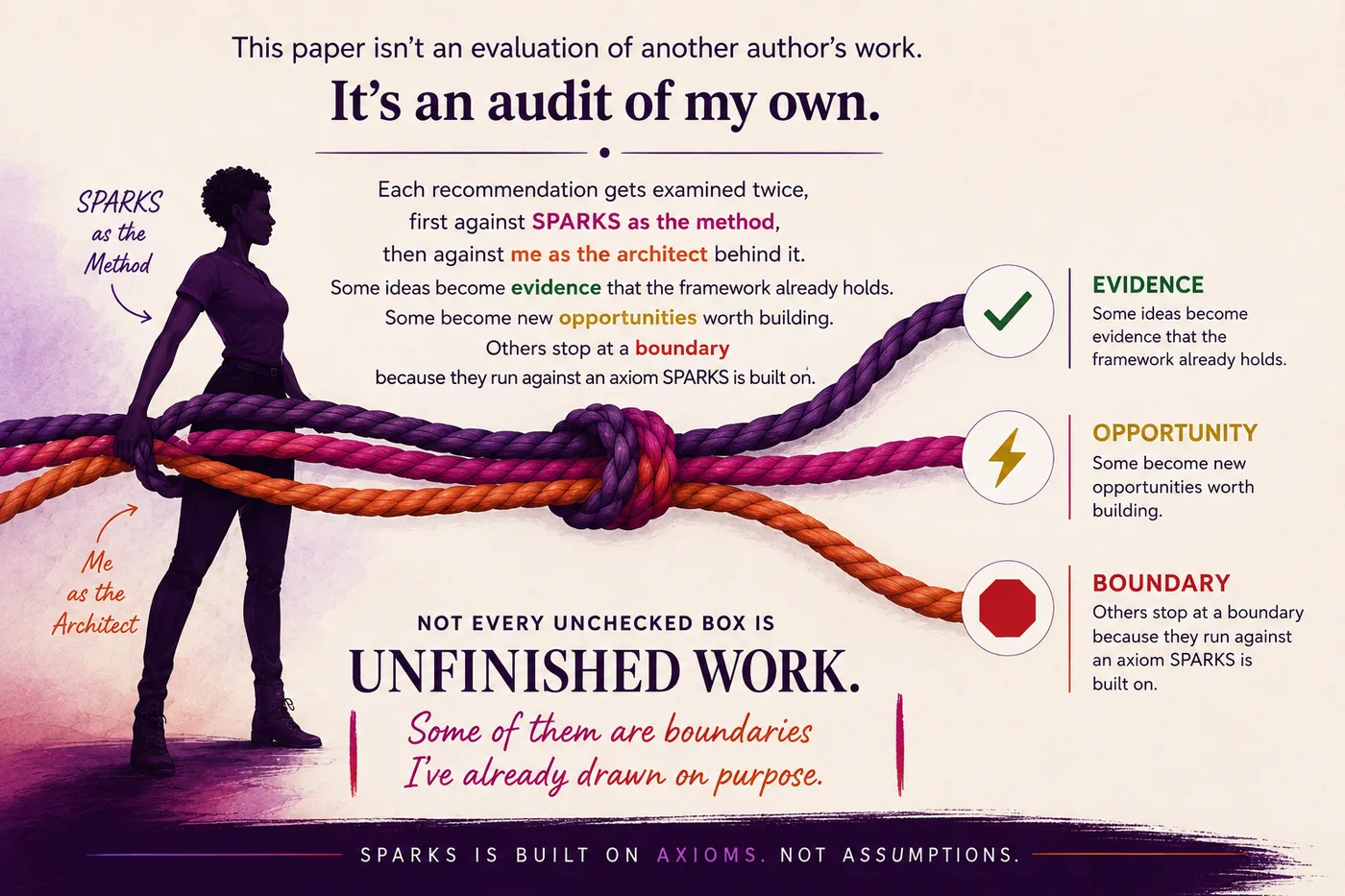
The audit doesn't end at the score. When a recommendation strengthens SPARKS, I study it and build it in. When it crosses an axiom, I leave it outside the architecture, and I still capture why, so my own understanding stays solid instead of drifting just because someone else's framework said so.
The goal stays the same.
What the Framework Actually Says
This one comes from AI Enablement Academy, posted publicly and titled "The AI Competency Framework." It's a dual-axis grid.
- Enablement Layer runs across (Augmentation, Automation, Agentic). Describes the impact radius of what you're doing with AI: whether it stays with you personally, moves into a process, or moves into a system that acts past the point of your hands-on involvement.
- Capability Level runs down (Foundations, Essentials, Fluency, Native). Describes how deep the expertise goes, from first exposure to a fully embedded default way of operating.
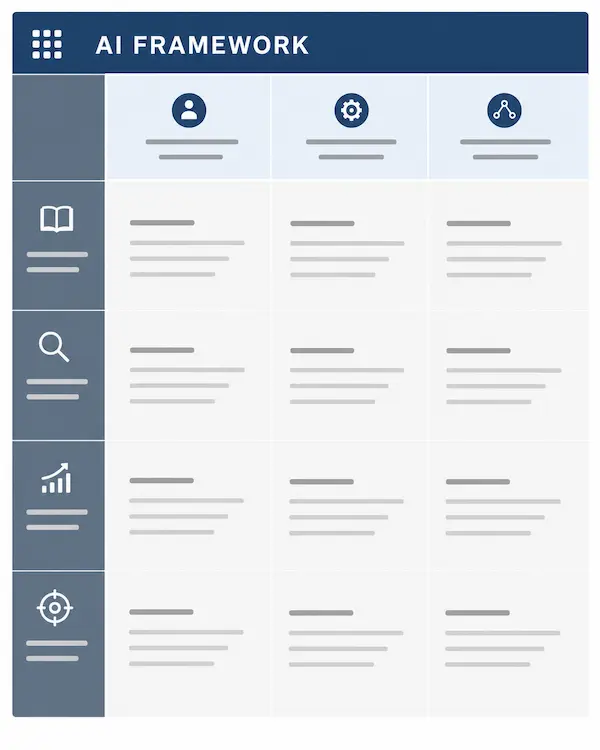
Twelve cells total. Each one makes a specific claim about what competence looks like at that intersection. The full text of each claim sits in the table below, next to where SPARKS and I land against it.
How to Read the Icons
This matches what SPARKS already does, or where I already operate. Not aspirational. Built, tested, or lived.
Not doing it yet. But it fits inside what I already believe. Identified, not built. Worth picking up.
I see it. I understand it. I'm not doing it. I'm not going to. This runs against the axiom SPARKS is built on.
The Framework, Against Both Columns
| Level | What the Rubric Says | SPARKS (Method) | Michelle (Personal) |
|---|---|---|---|
| Foundations | "Identify appropriate AI use cases in daily work and select AI tools that match task requirements." |
Ignition Point exists specifically to ask "do I actually need AI for this" before anything else happens.
|
Deliberately runs Claude, Perplexity, and ChatGPT as separate tools for separate jobs. Matching tool to task is already daily practice.
|
| Essentials | "Produce AI assets and artifacts using structured prompting with context control." |
SPARKS Builder is built for exactly this: structured prompting with context control as the core mechanism, not an add-on.
|
The entire position paper suite (Obsessed series, one-pagers) is produced this way already.
|
| Fluency | "Design and create custom AI assistants and tools integrated into your stack." |
No custom AI assistant product yet integrated into the SPARKS stack itself. Fits the method, hasn't been built as a tool.
|
Haven't built a personal custom assistant trained on SPARKS material yet. An obvious next thread, not started.
|
| Native | "Operate with an AI-first personal workflow where automation and agentic delegation are default modes." |
"Automation and delegation as default modes" skips the gate entirely. Ignition Point exists so the question (do I actually need AI for this) gets asked before any tool is touched, and ARC Boost adds friction after that, not instead of it.
|
Every piece of AI output still gets read and argued with before it ships. Default-mode delegation isn't the goal.
|
| Level | What the Rubric Says | SPARKS (Method) | Michelle (Personal) |
|---|---|---|---|
| Foundations | "Map existing processes to identify automation opportunities with conditional logic and error handling." |
FUEL's design already maps the readiness process before any automation gets layered on top of it.
|
Decades of mapping process gaps before recommending a fix. This is the day job, not new territory.
|
| Essentials | "Build AI-enabled interactive tools using no-code platforms. Take vibecoding seriously." |
Masteriyo on WordPress, native blocks, no-code build. The FUEL course itself is the proof.
|
Building the FUEL course inside Masteriyo right now, no-code, by hand.
|
| Fluency | "Create multi-step workflows with agentic nodes and platform-integrated integrations." |
The Intelligence layer is designed to hold multi-step data and workflow logic. Architected, not yet live.
|
Airtable is set up as the intended analytics home. Not yet wired into a live multi-step workflow.
|
| Native | "Deploy production-grade automation infrastructure with versioning and handoff protocols." |
Mission Control is designed as the handoff and accountability layer. Conceptually built, not yet deployed at production scale.
|
Not there yet. FUEL hasn't launched, so production-scale deployment protocols are ahead, not behind.
|
| Level | What the Rubric Says | SPARKS (Method) | Michelle (Personal) |
|---|---|---|---|
| Foundations | "Apply agentic system design principles to architect AI-native solutions with context management and memory." |
Mission Control already deals in context and decision-memory conceptually. The design principles aren't formalized as a taught topic yet.
|
Understands agentic architecture in theory through research and coursework, hasn't formally applied it.
|
| Essentials | "Design organizational knowledge systems with MCP integrations, custom skills, and documented decision logic." |
Decision logic is documented across SPARKS materials already. MCP integrations and custom skills are not.
|
Identified as a next thread, if it earns a place. Not built.
|
| Fluency | "Build production-ready agentic systems with PRD-driven development, testing protocols, and deployment." |
Production-ready agentic systems, by definition, run without a human approving each step. That's the exact trade the Master Thesis rejects.
|
Outside the lane on purpose. Not a skill gap. A boundary already decided before this framework showed up.
|
| Native | "Scale agentic systems across teams with governance frameworks and organizational memory architecture." |
Scaling agentic systems across teams with governance frameworks is the "remove humans from the loop" argument at organizational scale. SPARKS exists as the counter-argument to this, not a competitor building toward it.
|
Not the work. Ownership and accountability shouldn't be automated. That line was drawn before this grid existed.
|
What the Table Doesn't Say Outright
Reading down and across: Augmentation is mostly green. Automation is mostly gold. Agentic gets heavier red the deeper it goes.
That's not a coincidence and it's not a weakness. It's the shape of a method that was built around the individual first, is actively building the process layer now, and has already decided where the system-level line sits before getting there.
Every spark icon in this table marks something identified but not yet built: Airtable's intelligence layer, Mission Control's deployment protocols, a custom assistant that hasn't been made yet. These aren't gaps discovered by this framework. They were already on the build list. The framework just gave them a place to sit next to what's already live.
The Agentic Fluency and Native rows are where the framework's rubric and SPARKS's foundation actually disagree. The framework treats full autonomous agentic scale as the top of the ladder. SPARKS's Master Thesis treats it as the exact trade that's been made with every efficiency tool for decades (remove the human knowledge, keep the output) and says no, not this time. Grading low here isn't losing the audit. It's the audit doing its job.
The honest gap isn't philosophical. It's the gold column. Intelligence layer, Mission Control deployment, a personal custom assistant. Those are threads already named, sitting behind FUEL in the build order. This table didn't invent them. It just made them visible next to a rubric someone else wrote.
The mind is the first tool, not AI
This is an axiom, not a preference: AI fluency means knowing which tool fits the moment, and that decision starts in your own head, not in an app.
Fluency in a language isn't measured by how many years you sat in the classroom. It's whether you still have to translate in your head before you speak, or whether the language just runs. Most people who took years of a language in school never get past recognition. They can pick out a word here and there, but they're not fluent.
Real fluency means you stopped translating. You think in it.
AI fluency works the same way. Reaching for AI on everything isn't fluency. It's still translating, every time, instead of knowing when you already have the answer natively. Ignition Point exists to build that muscle: the question runs in your own head, before any tool opens, until it's not a step anymore. It's just how you think.
The alternative isn't hypothetical. Years of conversation with a high school principal, watching the same pattern repeat every year: students who can't read a paragraph, pull out the point it's making, and say whether that point actually holds up. That erosion of critical thinking was happening before AI ever entered the room.
AI didn't create it. It just gives people a new way to skip the same step: accepting AI's confident answer without asking whether it's right, and why it's right. "AI-first, delegation as default" doesn't fix that. It hands the thinking to the tool before the tool was ever asked whether it was needed, and calls it fluency. It isn't.
Fluency is restraint plus judgment.
Reaching for AI because it's there isn't necessarily a skill. It can be a crutch, and which one it is depends entirely on whether you know why you reached for it in the first place.
I didn't read the rubric first. But I'm not afraid of it either.