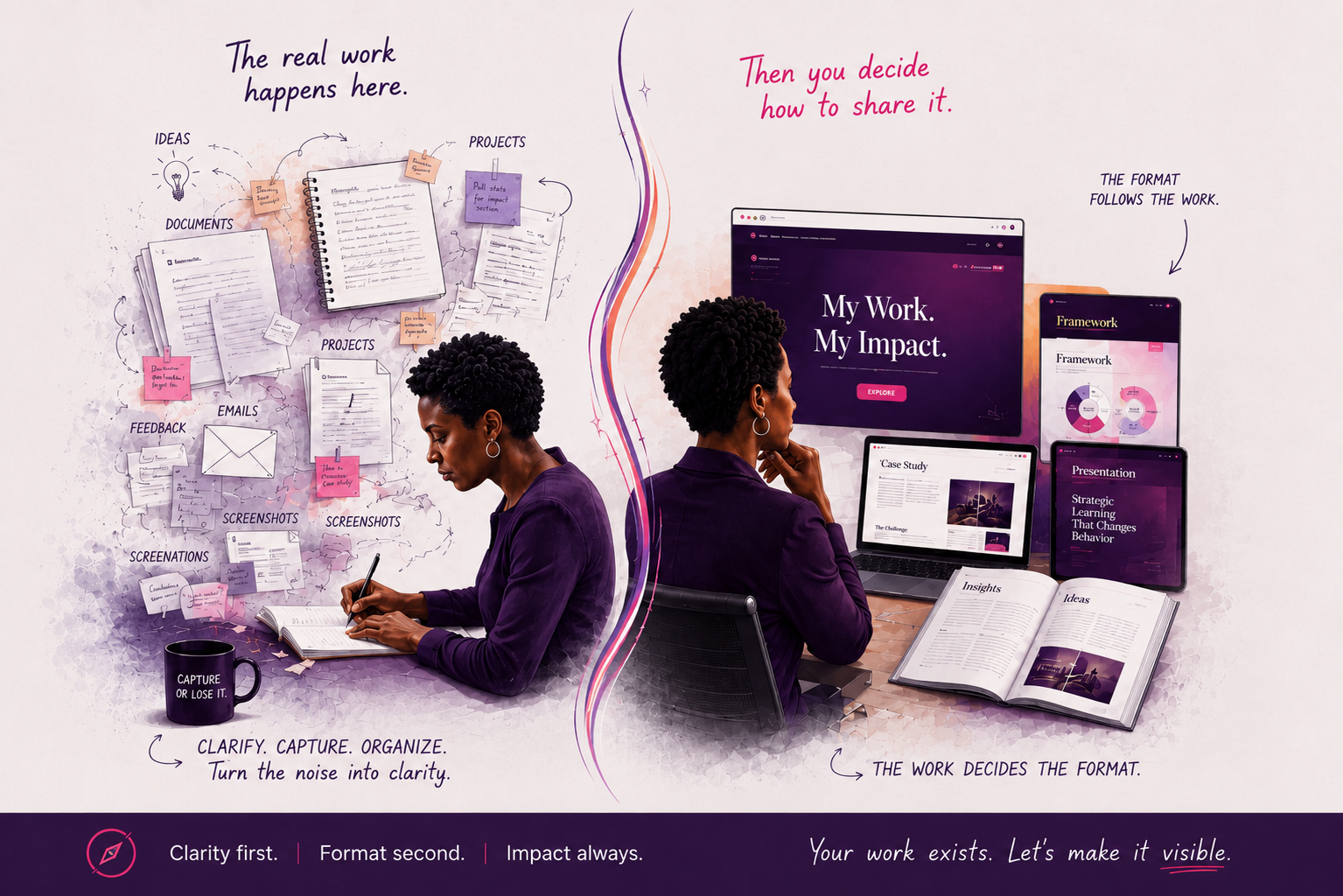
The work is the portfolio.Everything else is just how you choose to share it.
You Already Have
a Portfolio
Your work exists. This is how you find it, organize it, and decide how to share it.
Jump straight to the tool ↓When I began building my own portfolio, I thought the hard part would be the website.
It wasn't.
I discovered the real work started long before I chose a platform. It was identifying what I'd done, capturing it before I forgot it, and organizing it into something I could retrieve quickly and others could understand easily. Once I could see the whole picture, choosing how to showcase each piece became a much smaller problem.
Because the build, whatever format it takes, isn't the portfolio.
The work is.
📱 → 💻 Best used on a tablet or larger screen.
A phone will load it, but plan to use a tablet or computer when you're ready to actually dig in.
A thinking tool. Not a builder.
There are plenty of tools that will build a portfolio for you. I wanted something different, so I built this around the thinking process I used to create my own.
It won't build your portfolio or tell you what it should look like. It'll help you figure out what you have, what it demonstrates, and how you want to share it — the writing and the decisions stay yours.
Your thinking stays with you, too. Notes carry across tabs, but closing the tool clears them — copy what matters first.
Six tabs. Three parts. Start where you need to.
Work through one part, all three, or jump straight to any of the six tabs below — in whatever order makes sense for you.
Six tabs. Your pace.
What you capture in Find the Work carries forward automatically into later tabs.
Some tabs build on work you've captured elsewhere — they'll tell you what they need.
Your responses and Working Notes carry across tabs while you're here, but they aren't stored permanently.
Before You Leave
Before you close this browser tab, copy your Working Notes if you want to keep them. You'll have opportunities throughout the tool to do that.
Find the Work
What do I actually have?
Start with work you've already done — even if you're not sure it's worth including yet. This tab helps you surface experiences worth examining further.
What might be worth looking at? More than you first think.
A portfolio doesn't have to start with work that was officially called "Learning & Development." What problems have you solved? What have you figured out? What have other people relied on you for? Those are places worth looking.
Work I can show
Courses, job aids, presentations, guides, tools, communications, systems, processes.
Work that doesn't look like L&D yet
Transferable experience from operations, supervision, project work, customer service, tech, communications, process improvement.
Work I can't directly show
Proprietary or confidential — you may not be able to share the artifactThe actual document, deck, or file itself — as opposed to the story of the problem and decisions behind it., but you can still discuss the problem, role, and process.
"What changes when you stop asking, 'What can I put in a portfolio?' and start asking, 'What does my work already show?'"
- What problem did I solve?
- What did I have to figure out?
- What did I create, improve, coordinate, teach, explain, organize, simplify, influence, or change?
- What became easier, clearer, faster, safer, or more consistent because I was involved?
- What did other people rely on me for?
Talk through one experience, out loud or in writing, and this tool will ask a few follow-up questions to help you look more closely at what's there.
It works only from what you tell it — it won't invent details, and it won't decide what belongs in your portfolio for you.
Talk it through
This tool works only from what you tell it. It surfaces questions and possibilities — it doesn't decide what belongs in your portfolio, and it won't invent scope, metrics, or outcomes you didn't mention.
Show the Thinking
What does it demonstrate?
Pick one experience to look at more closely. This tab helps you notice what it may demonstrate — you decide what it means.
"I created onboarding materials" tells us almost nothing. What you had to figure out to get there tells us everything.
This tab takes one experience and helps you separate what you did from what it may demonstrate.
Think generally, not about a specific job posting — titles and responsibilities vary a lot between organizations. This shapes the questions we ask; it doesn't determine what your experience means.
Choose an experience to dig into:
Make the Decisions
What belongs?
Look across what you've surfaced and decide what belongs now, what might belong later, and what can be left out.
Having it isn't the same as it belonging. This one's on you — deliberately.
No AI here. This is where you practice the judgment nobody else can do for you: what deserves a spot, what can wait, what's duplicative.
When deciding whether an experience belongs in your portfolio, ask:
- What does this add?
- Who needs to see it?
- Is this my strongest example of what it shows?
- Does something else already do this job better?
- Is it useful even if it isn't polished yet?
"Leave Out" doesn't mean unimportant.
It means this experience doesn't need to do work in this portfolio right now.
Choose the Format
How could I share it?
Look at what you want to share and consider what kind of format could serve the work, the audience, and what you can realistically maintain.
This is not "what's the best portfolio format." It's "given what I have, what makes sense right now."
A website is not automatically superior. A PDF, a slide deck, a Google Doc of organized links — any of them can be excellent.
This is where the work starts taking shape.
Maybe you arrived here with experiences you've already examined and decided to include. Maybe you're just exploring what's possible. Either way, this section helps you move from the work itself to the many ways it could be shared.
Explore as much or as little as you want. You'll find formats, tools, places your work can live, and real examples. There isn't one right way to do this. The examples aren't here to recreate — they're here to give you something to react to, borrow from, push against, or use as a jumping-off point for your own ideas.
If you've been working through the earlier tabs: You found the work. You examined what it shows. You decided what belongs. Now: what could it become?
Want to browse first?
You can explore all five format families and example tools below, or answer a few questions and get 2–3 suggestions based on what you need right now.
The foundational distinction
Artifact vs. Container
Artifact
The actual piece of work
- Video
- E-learning
- Slide deck
- Case study
Container
Where someone finds the work
- Website
- Shared folder
- Linked document
- Portfolio hub
An artifact is the work. A container is where someone finds it.
You can have artifacts without a container, or a container that links to artifacts hosted elsewhere.
"Format" doesn't have to mean "website."
How soon do you need something usable?
How much ongoing upkeep sounds realistic?
What kind of material do you actually have to show? (pick all that apply)
Who's this mainly for?
How much of this can you share directly?
How comfortable are you building something like this?
What do you want this to do right now?
Skip any you're not sure about — that's useful information too.
Make It Yours
How do I show up in it?
Look at how you're presenting your work and decide whether the voice, claims, and choices sound like you while still being credible for the audience.
Authenticity doesn't mean posting every unfiltered thought. Credibility doesn't mean sanding off everything distinctive.
Voice, credibility, and discernment — three ways to ask whether something is actually yours to share, said the way you'd say it.
AI can help here — but you stay in authority.
Use it to test wording, tone, and audience fit without handing over the point you're trying to make. The goal isn't to "professionalize" your voice. It's to help you say what you mean in a way you can stand behind. It may offer a possible rewrite to react to — keeping it, editing it, or ignoring it is always your call.
Voice
"I am a results-driven professional committed to excellence and continuous improvement."
"I get impatient when something's broken and nobody's fixed it in three months. So I fix it."
The first sounds professional. The second sounds like a person. It reveals something real: what frustrates them and what they do about it. The question isn't whether everyone would say it. It's whether you would — and whether you want to own it here.
Credibility
"Led a company-wide transformation that revolutionized how the organization approached learning."
"Rebuilt onboarding for three departments; new hires reached full productivity two weeks faster."
The first makes a bigger claim. The second makes a supportable one. Specific scope and an observable result give the reader something they can actually evaluate.
Discernment
"I almost quit twice during this project."
"The timeline changed twice, and I adjusted the plan both times without missing the launch date."
Both are true. What changed is where and how the story is being told. The first might belong in a personal reflection or blog. The second may better serve a portfolio where someone is evaluating the work. Discernment is deciding what belongs here, for this audience, and whether it needs to be adjusted to fit.
Try it on your own words
Paste a sentence or short passage from your bio, portfolio, About page, case study, or anything else you're considering sharing.
Voice
Does this sound recognizably like me?
What would I never actually say this way?
Credibility
Can I stand behind every claim here?
Am I saying what the evidence supports — or what sounds impressive?
Discernment
Does this belong here, said this way, for this audience?
What job is this sentence doing?
Want help with the wording?
Let AI suggest an adjustment.
Would you change anything?
Revise below, or leave it as is — "no change" is a completely valid outcome.
My voice standard
Based on what you just noticed, what do you want to remember when you're writing or reviewing your portfolio?
We'll clean up capitalization, spacing, and punctuation when you set it — your words stay yours. You can always edit it.
Test It
Is it landing?
Decide what you need to learn, who can help you learn it, and what you'll do with the feedback you receive.
Feedback is input. You still decide.
What are you actually trying to learn — and who's the right person to ask?
"What do you think of my portfolio?" gets you opinions. A specific question gets you information you can use.
Who can help you test what?
L&D peer
Can tell you whether the work and thinking make sense within the field.
Former coworker
Can catch places where what you've written doesn't match or fully explain work they actually saw you do.
Non-L&D person
Can reveal jargon, assumptions, or explanations that only make sense if someone already knows the field.
Someone who knows you well
Can tell you whether the portfolio actually sounds and feels recognizably like you.
Web/design reviewer
Can focus on navigation, readability, visual hierarchy, and the experience of using what you've built.
Target-audience / hiring perspective
Can tell you what they notice, understand, question, or still need when viewing it through the lens of the opportunity.
Plan the test
What am I trying to learn?
Be specific — this shapes who's worth asking and what to ask them.
Use the feedback
What did I hear?
Just what was said — not yet what it means.
What do I make of it?
Your interpretation — feedback isn't automatically fact.
What will I do with it?
Change something, or deliberately leave it — both are valid.
Feedback is input. You still decide.