A position paper
If They Just Managed Their People

A practitioner's counter-argument to replacing human leadership with AI coaching — and the measurement system that made the replacement look reasonable. Read straight through or jump to any section.

The Premise The Scorecard The Strings What Good Work Hides Shortcut or Shortchange If They're Not Managing What We Reward The Skeleton Where This Lands

The "Shortcut or Shortchange?" matching game pairs the shortcuts organizations take with the real work those shortcuts replaced. Take your time with it.

A Position Paper  ·  Michelle Deshotels  ·  2026

If They Just
Managed Their
People.

A practitioner's counter-argument to replacing human leadership with AI coaching — and the measurement system that made the replacement look reasonable.

"What gets measured gets done. The question is who designs the measurement — and what they leave off the list."

The statistic
1.5%
HR touches only 1.5% of the interactions that shape employee performance. Presented as a gap. But is it?
The real question
98.5%
Who should actually own the other 98.5%? The answer changes everything that follows.

I came across an AI coaching playbook built around a striking statistic. The number was presented as a gap. But I got stuck on the premise — and this paper is what happened next.

Scroll to explore

The question
behind the
statistic.

I came across an AI coaching playbook built around a striking statistic: HR touches only 1.5% of the interactions that shape employee performance. The number was presented as a gap. The proposed solution was AI embedded where employees already work — Slack, Teams, email — able to coach employees at scale, surface needs, assign development, and fill all of those spaces HR could never reach.

But I got stuck on the premise.

Why should HR be touching more of those interactions?

If an employee needs help navigating leave, an investigation, an employee assistance program, or another issue that legitimately belongs to HR, then HR should be there. But most of the interactions that shape an employee's performance should not belong to HR.

They should belong to the manager.

The manager is the person responsible for what happens in that 98.5%. Not HR. Not software. The manager.

The one-on-one.
The recognition.
The correction.
The conversation about where someone is struggling.
The decision that development is needed.
The follow-up afterward.
The ordinary, repeated work of knowing the people you lead well enough to recognize when something has changed.

If those things are happening where they are supposed to happen, HR touching 1.5% of employee interactions may not be evidence of a gap at all.

It may be evidence that the system is working.

And that changes the question completely. The question is no longer: How do we get HR into the other 98.5%? It becomes: What should be happening in the other 98.5%, and who actually owns it?

"Begin with the end in mind." — Stephen Covey

The wrong
scorecard.

Before interrogating a vendor's statistic, an organization has to interrogate its own scorecard. That is harder than it sounds.

A vendor published a playbook. It opened with a single number.
1.5%
HR only touches 1.5% of the interactions that shape employee performance.
They called it a gap. They had a solution ready.

Maybe they inherited the scorecard. Maybe someone built it years ago, for different goals, under different leadership. Then it kept getting used because changing it requires someone to say out loud: we have been measuring the wrong things, which means we don't actually know if we've been succeeding. Nobody wants to say that. So the scorecard stays. So how do you fix it?

★ Start Here
1. Define the goal before you build the scorecard.
2. What you measure is what you build toward.
If your goal is strong managers who develop their people — why are you measuring HR touchpoints?

HR touchpoints is the wrong metric entirely. It tells you how often employees went around their manager. In a well-run organization, that should usually be rare.

?Are one-on-ones happening consistently?
?Are people developing?
?Are employees being promoted internally?
?Where is voluntary turnover occurring, and is it clustering under particular managers?
?Are performance problems being identified early or appearing suddenly at year end?

Those measures get much closer to the thing we claim to care about.

🚩
The wrong scorecard made 1.5% look like a problem.
A better scorecard might have made it look like a sign of health. The vendor did not have to manufacture a crisis from nothing. They handed the organization a number that fit a box it already had. The box was already wrong.

Look for
the strings.

That distinction matters because a statistic does not have to be false to be misleading. The 1.5% can be completely real. The crisis it describes can still be invented.

In a functioning organization with capable managers, most day-to-day performance conversations belong close to the work. They belong with the person responsible for setting expectations, observing performance, understanding context, making decisions, and being accountable for what happens next. That is not evidence that HR is absent. It is evidence that HR is not the manager.

When a vendor hands you a statistic that proves you need the thing they happen to sell, the first question should not be "How do we fix this?"

Stop for two minutes.

That is not cynicism. It is discernment.

Questions worth two minutes
?Is this actually our problem?
?Does it actually need solving?
?Who benefits if we believe it does?

Organizations have accumulated hundreds of software applications not because every purchase was foolish, but because the easiest organizational problem to solve is often the one someone has already packaged, priced, and placed in front of you. The existence of a solution creates momentum toward accepting the problem. Urgency helps. A large number helps. A polished deck helps. But context matters.

You can manipulate data without falsifying a single number. Suppress the context. Shout the outlier. Choose which number goes on the slide and which numbers stay off it. The number remains true. The conclusion does not automatically follow.

The invisible tax
on good leadership.

Part of the reason these arguments work so well is that organizations are much better at seeing intervention than prevention. A fire is visible. Someone responds. There is activity, tickets, meetings, escalations, hours. People can point to what happened and say: look what we handled.

Prevention is quieter.
The one-on-one in month two that means there is no performance crisis in month eight.
The recognition that keeps a strong employee from quietly checking out.
The difficult conversation that prevents the resignation everyone would otherwise describe as having come out of nowhere.

When those things work, nothing dramatic happens. And "nothing happened" is difficult to put in a quarterly report.

🔥Fighting Fires
Visible. Everyone can see it.
Urgent. Creates momentum.
Gets credited in the quarterly report.
Gets resourced. Gets headcount.
Looks like effort.
🛡️Preventing Fires
Invisible. Nothing dramatic happens.
Quiet. Looks like nothing is wrong.
Gets overlooked. Hard to quantify.
Gets cut. First line item to go.
Looks like nothing.
The fires that never started can be counted. They often just aren't — because the team that prevented them was never asked to keep score that way.

That does not mean it cannot be measured. Organizations already have much of the underlying data. Payroll. Turnover. Employee relations cases. Support tickets. Absenteeism. Promotions. Performance trends. Manager-level differences. The problem is often not that prevention is impossible to measure. The comparison simply never gets built.

We rarely put "here is what we spent staying ahead of problems" next to "here is what we spent catching up to them." So the team fighting fires can look extraordinarily productive while the team that prevented them looks quiet. The better the system works, the less dramatic the work can appear.

When firefighting is what gets measured, firefighting is often what gets produced. That can look less like a staffing problem and more like an incentive problem.

Not every shortcut is a problem. Here is the difference.
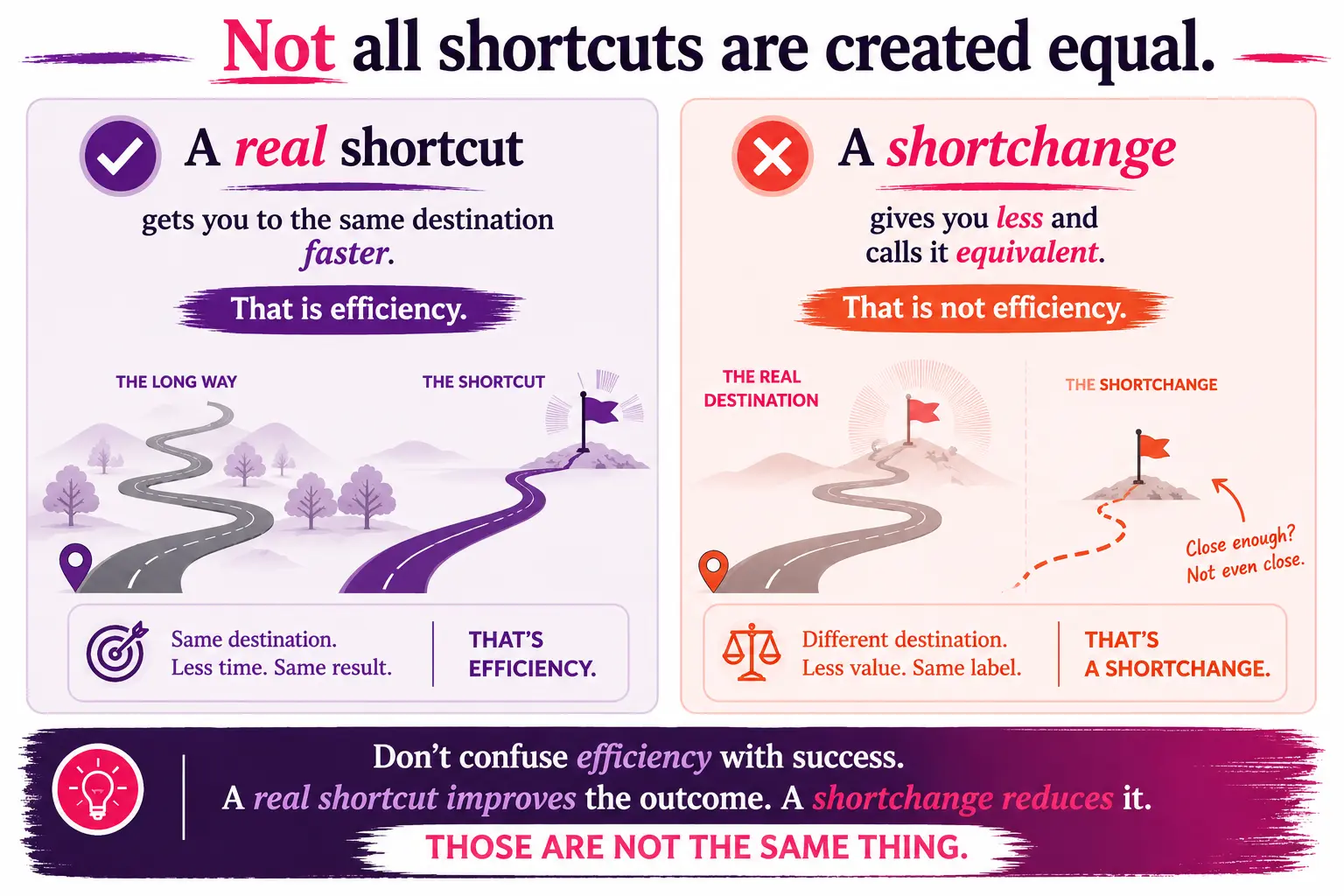
Not all shortcuts are created equal. A real shortcut gets you to the same destination faster — that is efficiency. A shortchange gives you less and calls it equivalent — that is not efficiency. Don't confuse efficiency with success. A real shortcut improves the outcome. A shortchange reduces it. Those are not the same thing.
Shortcut or Shortchange?
Can you spot the difference?
↓ Tap the arrow to play — can you match the shortcut to the real work it skipped?
These aren't shortcuts.
They're a worse result disguised as the same.

Not every shortcut is a problem. A shortcut that gets you the same result faster is efficiency. These aren't that.

Match each shortcut with the real work it skipped. Flip one pink card and one purple card to find a pair.

Pink cards
The Shortcut — disguised as the real thing
Purple cards
The Real Work — what actually produces the outcome
Real Work Revealed
You found all four pairs.

The shortcuts weren't the problem. Accepting their results as equivalent was. That's how organizations slowly shortchange their people.

This is where AI enters the conversation, but the pattern is older than AI. Organizations have always looked for ways to make expensive, difficult, human work easier to scale. There is nothing inherently wrong with that.

Called
A more efficient version of manager development
Actually
Promoting the strongest individual contributor without teaching them what changes when they become responsible for other people. Missing manager development entirely.
Called
A more scalable version of leadership development
Actually
Replacing sustained leadership development with a software subscription. It may simply be less leadership development.
Called
A faster version of good management
Actually
Allowing AI to identify the need, assign the intervention, and notify the manager afterward. It doesn't change the speed. It changes who made the decision.
A manager can be technically "in the loop" without being in authority.
Those are not the same thing.

Here is what that looks like in practice.
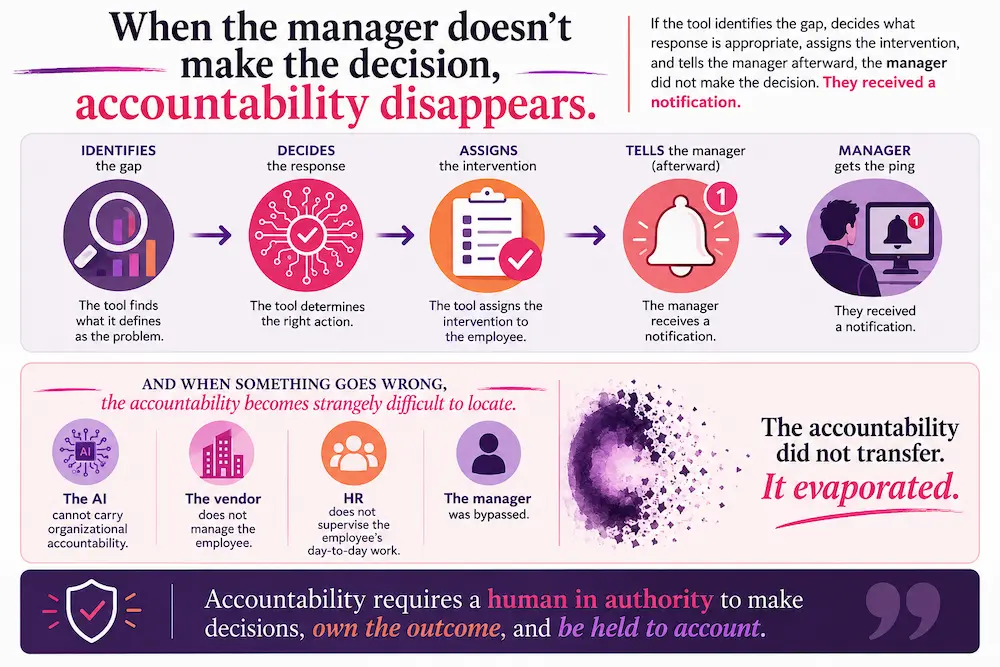
When the manager doesn't make the decision, accountability disappears. A flow showing: The tool identifies the gap, decides the response, assigns the intervention, tells the manager afterward. The manager gets a ping. When something goes wrong, the AI cannot carry accountability, the vendor doesn't manage the employee, HR doesn't supervise day-to-day work, the manager was bypassed. The accountability did not transfer. It evaporated.

The accountability did not transfer. It evaporated.

AI can research options. It can surface patterns. It can identify signals a human might miss. It can reduce administrative work. It can make the manager better equipped to make a decision. But the person with responsibility for the employee should remain the person with authority over the decision. The human should not merely be in the loop. The human should be in authority.
If the manager
isn't managing.

There is an obvious objection to all of this. What if the manager is not doing their job? What if the reason employees need another path is that their manager is disengaged, untrained, inconsistent, or simply bad at managing?

That is a real problem. But routing around the manager does not solve it. It conceals it.

A disengaged manager can ignore an AI coaching notification just as reliably as they ignored the employee before the tool existed. A manager who does not know how to have a developmental conversation does not become capable because software identified the need for one. A manager who was promoted because they were technically excellent but never taught how management differs from individual contribution does not need to be bypassed.

They need to be prepared.
"There is no failure for finding yourself unprepared for a job you weren't prepared for."
— Sgt. Wade Grey, The Rookie

That is the distinction organizations too often collapse. Being unprepared is a condition. Failure is a judgment. If someone was placed into a role without the preparation required to do it well, the first question should not be why they failed. It should be whether the organization did its part before asking them to perform. The onus does not begin at the bottom.

Teach the transition.
Teach what performance management actually looks like across a year, not just at appraisal time.
Teach managers how to set expectations, recognize patterns, have difficult conversations, develop people.
Give them practice before the situation is real. Give them peers. Give them experienced leaders to learn from.
Give them clear expectations. Then hold them to those expectations.

And if a manager has been prepared, supported, given clear expectations, and repeatedly refuses to manage, that is no longer a development problem. It is an accountability problem. Technology cannot solve an organization's unwillingness either to prepare its leaders or to hold them accountable afterward.

One standard
for tools.
A different one for people.

Priority statements reveal values more reliably than mission statements ever will.

Some organizations genuinely do not know their scorecard is wrong. Their measures evolved over time, nobody reconnected them to the goal, and eventually activity became a proxy for value. That can be fixed.

But sometimes the organization does know. It knows development takes time. It knows good onboarding requires investment before productivity appears. It knows managers need preparation. It knows people need time away from immediate production to learn. It knows prevention is less expensive than repeatedly repairing failure. And it chooses the quarterly number anyway because the quarterly number is what gets reported and rewarded.

A system built to reward short-term gains will produce short-term decisions. Not because everyone inside it is malicious. Because rational people respond to the incentives in front of them.

Gets waved through
AI coaching tools — approved on the promise of scale
No proof of adoption required. No measurement plan.
Tap to see what gets interrogated
Gets interrogated
Leadership development — requires a full business case
A measurement plan, a champion, and proof up front — for the investment with the highest known return.
Tap to flip back
Gets waved through
Executive offsites — tens of thousands to reenact consensus
Filed under leadership. No measurement framework required.
Tap to see what gets interrogated
Gets interrogated
Letting people go to a class
Managers block it because it shows on productivity metrics. The cost of keeping them at their desks: invisible.
Tap to flip back
Gets waved through
New software — deployed without adequately training the people using it
Nobody required proof that the training was sufficient.
Tap to see what gets interrogated
Gets interrogated
Onboarding that ensures staff are prepared to do the actual job
Not just aware of it.
Tap to flip back

Each card shows what gets approved without question — flip it to see what faces scrutiny instead.

Priority statements reveal values more reliably than mission statements ever will.

They funded the tool.

They did not fund the people.

And nobody made them justify that choice.

Good leadership makes
the structure strong
enough to hold.

There are organizations that have successfully built strong peer accountability, empowered teams, and employees capable of operating with enormous autonomy. That should be the goal.

But there is a dangerous leap from: the system is strong enough that leaders do not need to intervene constantly — to: the leadership structure is no longer necessary. Those are not the same thing.

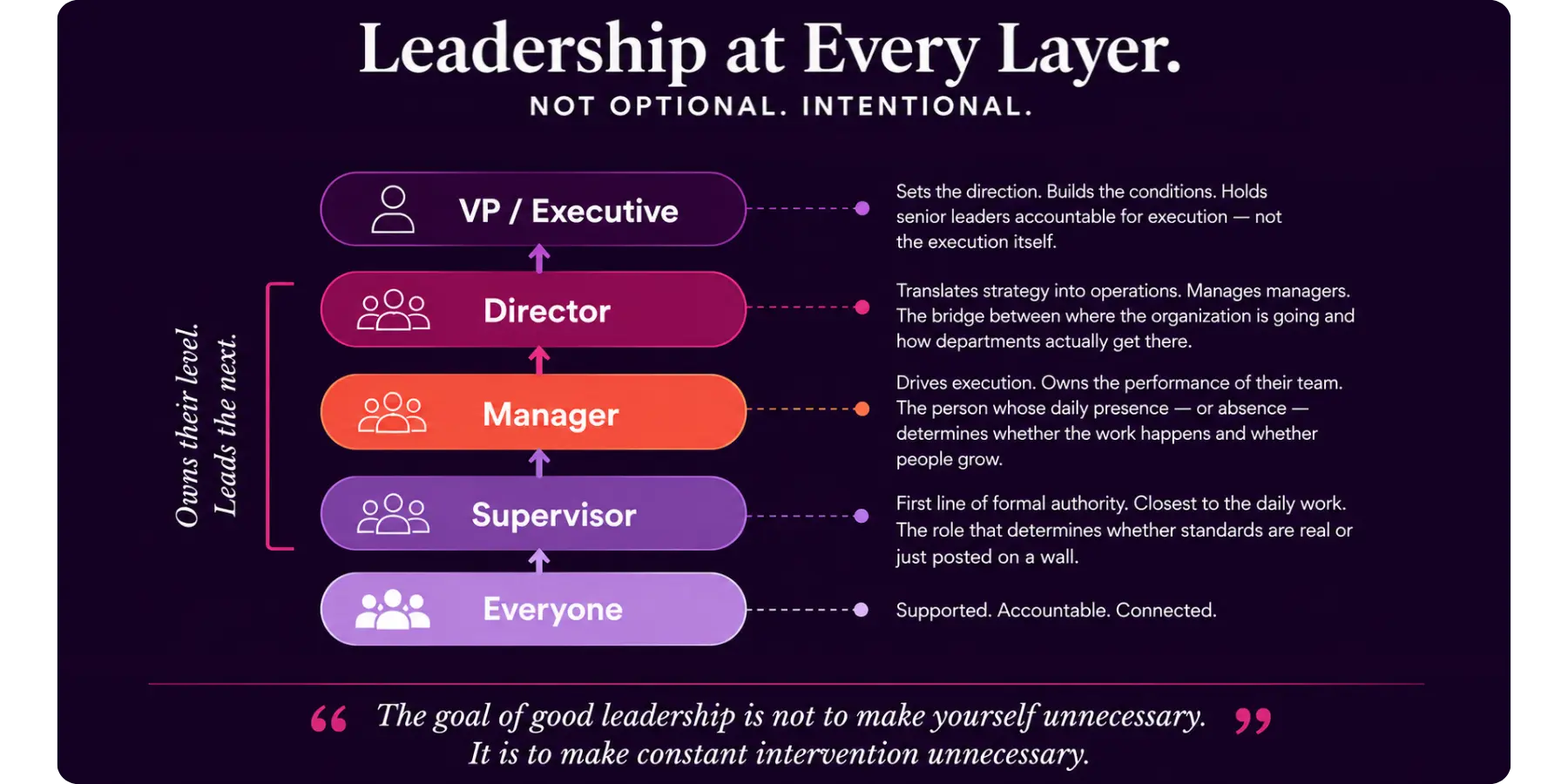
Good leadership does not make structure disappear. Good leadership makes the structure strong enough to hold. Every level owns its responsibility. Every level develops the next. Authority is clear. Accountability is clear. People understand what belongs to them. The leader can step away from constant intervention because leadership exists throughout the system.

Leadership at Every Layer — VP/Executive sets direction, Director translates strategy, Manager drives execution, Supervisor is first line of authority, Everyone is supported and accountable. A bracket on the left spanning Director through Supervisor reads: Owns their level. Leads the next.
The goal of good leadership is not to make yourself unnecessary. It is to make constant intervention unnecessary.

That is why routing around the manager is the wrong answer to weak management. If the skeleton is poorly constructed, build it correctly. Do not remove it and then wonder why the body cannot stand.

An AI coaching system that identifies the need, acts on the employee, and informs the manager afterward makes the same conceptual mistake. It sees the management layer as friction. It optimizes around it.

Keeps the body. Removes the skeleton.
Calls it innovation.

The reason it looked unnecessary is because it was doing its job. That is not evidence it was expendable. That is evidence it was working.

Where This Lands
Sometimes 1.5% is exactly right.

If managers know their people, have the difficult conversations, identify problems early, make development decisions, and are held accountable for doing those things well — then most of those interactions are already exactly where they belong. With the manager. The number is not a gap. It is the system working.

And if managers are not doing those things, the organization has learned something important. It has a problem. Just not the one the statistic claimed.

The answer is not more HR touchpoints.

The answer is not AI in Slack.

The answer is much less novel.

If they just managed their people.

See the portfolio →

Where the cited data comes from