Built for desktop or tablet — the two-column layout needs the room.
🧭
Use the menu up top to jump straight to a section, or just scroll.
🔄
The bar below the menu is the full performance cycle. This piece lives in one stop on it — Ongoing Performance.
📖
Need a definition? Find the Glossary top right, or the tab along the side.
Built for the desktop or tablet (landscape) experience — the two-column format needs the room.
Goal Setting
coming in this series
Ongoing Performance
you are here
Self-Appraisal
coming in this series
Manager Appraisal
coming in this series
Back to Goal Setting
the cycle repeats
A Soft Skills Practice
All About Me
Your work. Your growth. Your record.
Part of a Series
Performance management isn't an event. It's a cycle that never stops.
You already know the pieces — goals get set, work happens, performance gets discussed, appraisals get written, and eventually the cycle starts again. This series isn't here to reteach that process. It's about a few of the practices inside it that can make the whole thing work better.
All About Me sits here, in Ongoing Performance. It's a simple habit: keeping a record of the work while the work is happening.
Goal Setting
Where the period's direction gets set.
coming in this series
Ongoing Performance
The work itself — and the habit of keeping a record of it.
this piece
Self-Appraisal
Turning the record into your own account of the period.
coming in this series
Manager Appraisal
Your manager's independent account — meant to add what only they can see.
coming in this series
Back to Goal Setting
Then it starts again.
the cycle repeats
This piece stays with Ongoing Performance — what you capture, why you capture it, and what you do with the record along the way. What that record becomes useful for later — including the self-appraisal — is where the rest of the cycle comes in.
How do you keep track of everything you've done — for a self-appraisal, for a resume that's gone stale, for the conversation where someone asks "so what have you been working on" and your mind goes blank?
This can be a hard question to answer — not because you haven't done the work, but because tracking it in real time takes discipline.
By the end of this
1 You'll know what actually belongs in a running record of your own work.
2 You'll recognize halo/horn and recency bias as reasons memory alone isn't a reliable record — not just be able to define them.
3 You'll know how to use the record while the work is happening, not just save it for later.
4 If you lead people, you'll know what to watch for beyond just praise — including the stuff nobody puts on a slide.
Why It Matters
Your brain isn't the problem. Your brain not keeping a record is.
Two things quietly make memory an unreliable record, and neither one is about anyone being a bad person.
There's the halo/horn effect, where one strong or weak moment ends up coloring an entire evaluation, even though it has nothing to do with the rest of the work. And there's recency bias, where whatever happened in the last six weeks quietly outweighs the other ten and a half months, simply because it's freshest in memory.
Neither one requires a bad manager. They require a manager — or an employee — with a normal human memory and no system for keeping it honest.
❓ Q&A — Try It
A manager sits down to write a review. The employee had a rough final quarter after a genuinely strong first three. The manager writes: "Performance has been inconsistent this year." What's actually happening here?
That's recency bias. Three strong quarters got flattened by one weak one — not because the year was actually inconsistent, but because the most recent stretch is what's easiest to remember without a record to check against.
The Notebook
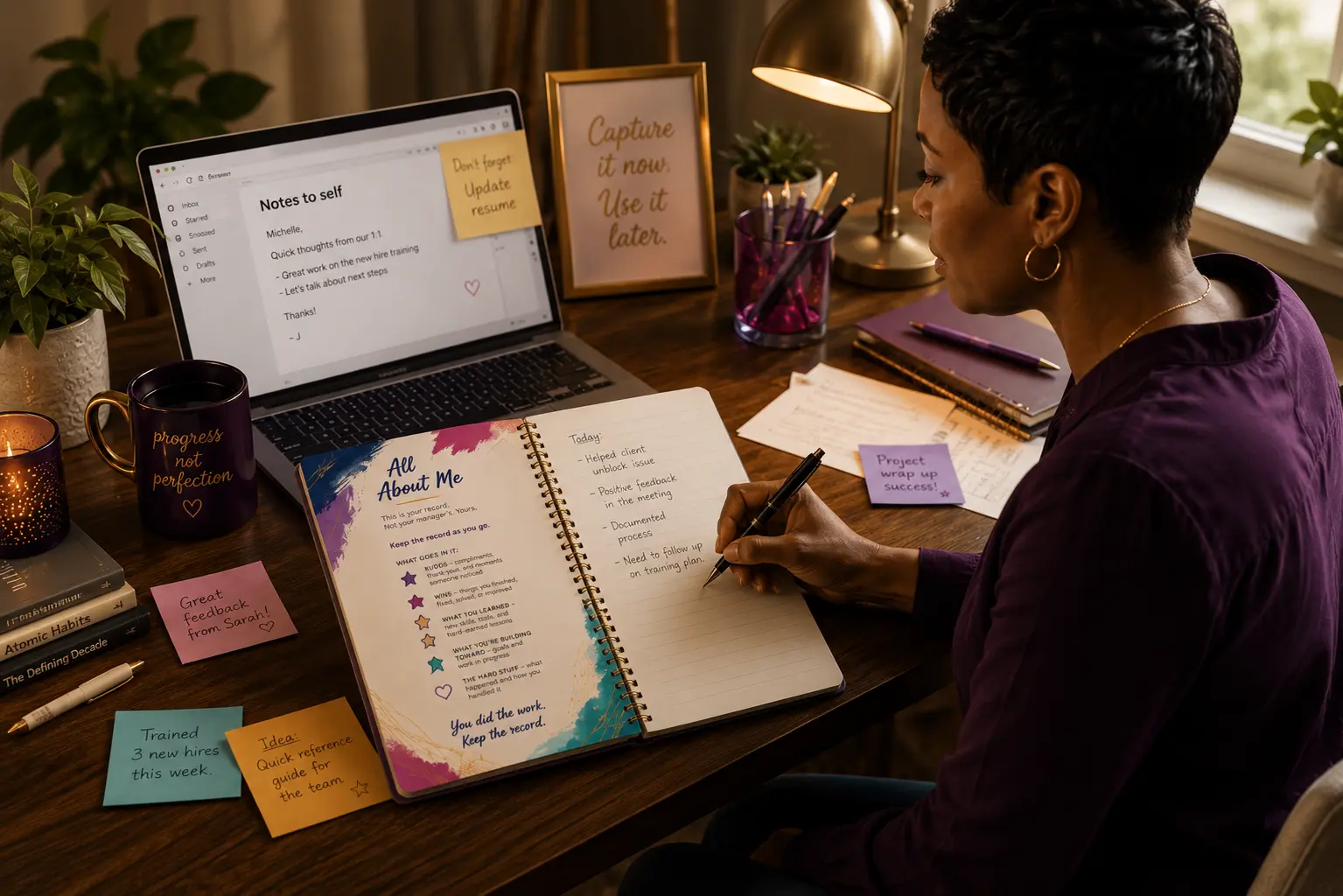
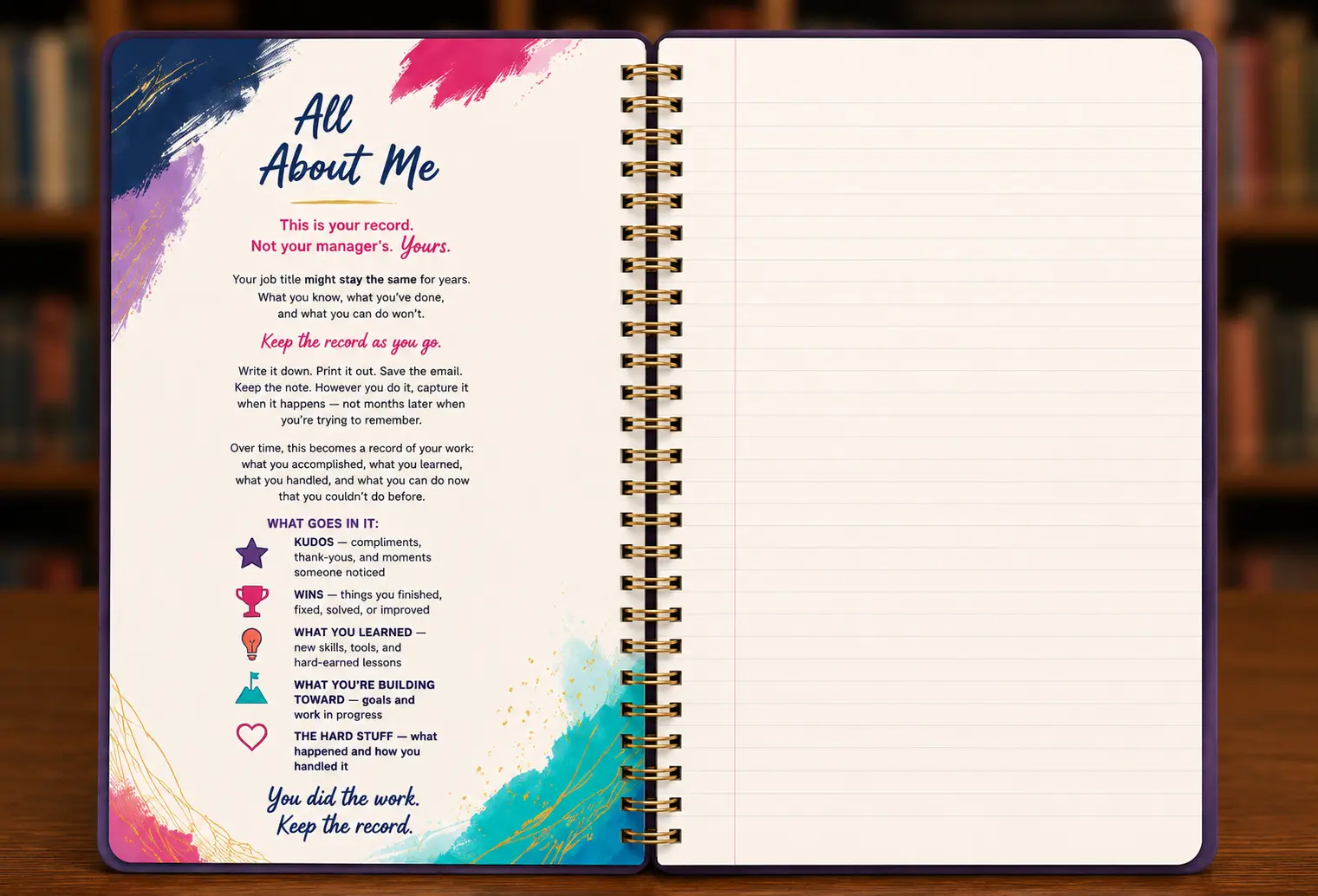
This started as an actual notebook.
Every staff member got one — including me. We wrote on the pages, and stapled in kudos emails as proof — whatever felt worth keeping.
That was the version the technology of the moment made possible.
The original insert, more or less — I don't have the exact wording from the 2000s anymore, but the idea never changed.
The container changed. The habit didn't.
📓 A physical notebook, the 2000s
→
📧 An email folder called "All About Me"
→
✨ Whatever actually works for you
Later, the notebook became a folder in my inbox — I'd drag things in, save what people sent, sometimes email myself something specific just so it would be captured.
The name stuck because the point was never the object.
It was writing it down when it happened, not months later when you're trying to remember.
What Goes In It
Kudos. Wins. What you learned. What you're building toward. The hard stuff.
Same five categories, whether you're tracking your own work or someone else's.
⭐
KudosA compliment, a thank-you email, a "you saved us" moment.
💡
What you learnedA new skill, a new tool, something you figured out the hard way.
🏆
WinsSomething you finished, fixed, solved, or improved.
🚩
What you're building towardA goal in progress, not just goals completed.
❤️🩹
The hard stuffWhat happened, and how you handled it.
Individual Contributor
Leader
What this looks like for you
Every one of the five categories is about your own work. Not what you think you should be doing — what actually happened.
"Helped the finance team unblock an onboarding issue. Wasn't in my job description. Took two hours. Now their whole department runs through the same process."
What this looks like for you
Same five categories — but you're keeping this for every person on your team, and in more detail than they might keep for themselves, because you have access to things they don't: metrics, cross-team feedback, patterns over time.
"Sarah's Q2 metrics were flat, but she trained three new hires that quarter — nowhere in her numbers, entirely in mine."
The One-on-One
This is where the record actually gets used — not just kept.
If All About Me is doing its job, nothing on the appraisal is news to either person. It's already been said out loud, regularly, in the room where it mattered.
Individual Contributor
Leader
Bring it up before you're asked
Many one-on-ones default to organizational topics — what's on fire, what's shipping. The smaller wins don't come up unless you say them out loud.
"I wanted to flag something — a director from another team came to me directly about extending our onboarding process to their department. We built it together. It's now their standard for new hires, not just something I helped with once."
✦ Real Talk
Model it. This isn't only your manager's move to make. If a peer mentions something they're proud of, a quick "did that make it into your All About Me?" does the same thing for them.
Model it, don't just collect it
When a kudos email lands in your inbox about someone on your team, forward it. Ask the question out loud.
"I got this email from the client about the training rollout you led — did you put this in your All About Me yet? You should."
✦ Real Talk
Watch for the flip side too: a report quietly absorbing another department's workload isn't the same as a report doing great work. If someone's covering ground that isn't theirs, that's a staffing conversation, not just a compliment.
Practice
Where are you already doing this?
Check anything that's already true for you. Then read the note that shows up below — it'll be different depending on how much you checked.
I've saved a compliment or thank-you email somewhere on purpose.
I could name three things I finished or fixed in the last quarter without stopping to think hard.
I've written down something I learned this year, not just experienced it.
My resume is current enough that I could send it out this week.
I've brought up a win in a one-on-one before being asked about it.
This is for your own thinking — nothing typed here is saved.
Other Ways To Capture This
The point is the habit, not the format.
It doesn't have to be an email folder. It doesn't have to be a notebook. It has to be somewhere you'll actually use.
Email folder
Physical notebook
Notes app
Slack saved messages
Spreadsheet
Voice memos
A running doc
Thanks — capturing that. Ways of doing this keep surfacing that I never would have thought of on my own, and that's exactly the point.
This piece is a demo. In a live version, responses like yours would build a real, growing list over time — the kind of thing I'd follow up on with a "thanks for sharing how you actually do this" note after a session. Here, it's an honest approximation of that idea, not the finished system.
Before You Go
What this is, and what it isn't.
Individual Contributor
Leader
Is this a requirement?▾
No. Nobody is auditing your All About Me. It's a practice, not a policy. The value shows up the first time you need to remember something and you actually can.
Isn't this just self-promotion?▾
It's the opposite of performing for an audience — it's a private record you keep whether or not anyone's watching. Self-promotion is convincing someone. This is just knowing.
What if my manager just uses what I wrote, almost word for word?▾
That's not a problem with your record. If what you captured was accurate, specific, and useful enough to carry forward, All About Me did its job. You kept the record. That's the job of this practice. What someone else does with it is a different conversation.
Does this replace one-on-ones?▾
No — it's what makes them richer. Without a record, one-on-ones can default to whatever's on fire, what's due, or the metrics in front of you. With one, there's something real to talk about beyond the immediate work — what you're building toward, not just what's burning.
Is this a requirement?▾
No — but if you're not doing this for your team, you're relying on memory alone at review time. Memory alone is exactly where halo/horn and recency bias live.
Isn't tracking this for every person on my team just extra admin?▾
It shouldn't be a second job. Capture things as they happen, then use the record in conversations you're already having — especially one-on-ones. A few lines kept along the way are more useful than trying to reconstruct a year later.
My team member's entries and mine end up looking pretty similar — is that a problem?▾
Not on its own — you're both watching the same work. What makes your version worth keeping separately is the pattern only you can see across a whole team, not just one person's account of their own year.
Does this replace regular one-on-ones?▾
No — it's what makes them richer. Without a record, one-on-ones can default to whatever's on fire, what's due, or the metrics in front of you. With one, you've got material to expand the conversation beyond status — into development, growth, and where someone wants to go next.
One Record, Many Uses
Performance appraisal is just one of the places this shows up.
Not every organization does formal appraisals. Not every role has one every year. That's not a reason to skip this — appraisal was never the whole point.
Self-appraisal
You're not starting from a blank page or a foggy memory.
The one-on-one
You walk in with something to say, not just something to hear.
Your resume
Updated from truth, not reconstructed from guesswork six months later.
The next role
Proof of what you can do — not just what your title says you did.
The hard conversation
If someone tells you something different from what you know to be true, you have more than a feeling.
These are just a few — once you have the record, the uses are endless.
You Can Now
✓ Name what actually belongs in a running record — and start one, in whatever format you'll really use.
✓ Recognize halo/horn and recency bias as reasons memory alone isn't enough — not just define them on a quiz.
✓ Use the record while the work is happening, not just save it for later.
✓ If you lead people — know what to watch for beyond praise, including the stuff nobody volunteers.
You did the work. Keep the record.
All About Me lives in the ongoing performance part of the cycle — while the work is happening, not months later when someone asks you to remember it. The record you build here can go with you into a one-on-one, a self-appraisal, a résumé, your next role, or somewhere you haven't needed it yet.
Once you have the record, you decide where it goes next.
Glossary
Halo / Horn Effect
A single trait — good or bad — colors an entire evaluation. One great presentation makes everything else look great too, even unrelated things. One bad month makes everything before it disappear.
Recency Bias
Whatever happened most recently gets remembered clearest and weighted heaviest, even when it's not representative of the whole period being evaluated.
Performance Management
The ongoing cycle an organization uses to set direction, track work, and evaluate it — goal setting, ongoing performance, self-appraisal, and manager appraisal, repeating. Not a single event; a loop.
One-on-One
A regular, recurring conversation between an employee and their manager. It may include current work and performance, but it should also make room for feedback, development, career goals, and opportunities — not just status updates.
Self-Appraisal
The employee's own written account of their performance over a period, usually submitted before or alongside the formal review.
Manager Appraisal
The manager's own written evaluation of an employee's performance — meant to add the manager's vantage point, not restate the self-appraisal.
All About Me
A running personal record of your own work — kudos, wins, what you learned, what you're building toward, the hard stuff — kept as it happens, in whatever format actually works for you. The name of the practice, not a specific object.